

The leak is in the waterproofing membrane, which is buried under the green roof substrate, planting and drainage layer, so nobody can see it. You can find a leak in a green roof in one of two ways: strip the overburden completely to expose the membrane and carry out electronic leak detection, or carry out a Buried Leak Location (BLL) survey, which reads the membrane through the build-up without removing the green roof. The way to avoid this expensive and disruptive investigation altogether is to install a permanent leak detection sensor system within the roof build-up.
That is the short version. The rest of this page is why each part of it is true, because the instinct most people have with a green roof leak, which is to open up above the wet patch, is the expensive one.
Start inside, but don’t trust what you see
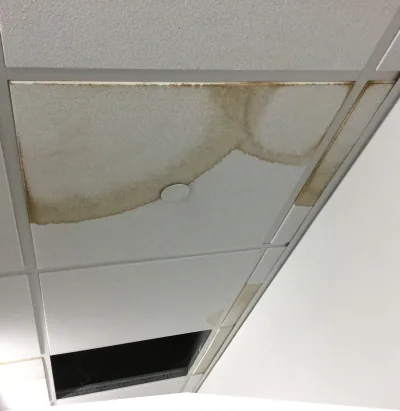
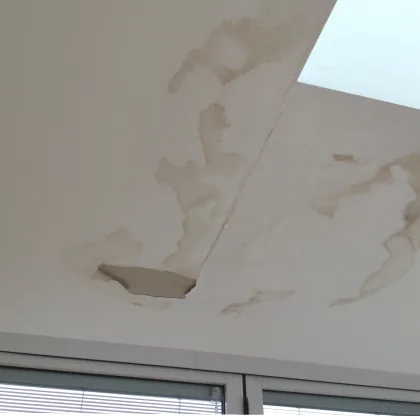
The first useful work is done in the building, not on the roof. Map every point of ingress onto a copy of the roof plan: which rooms, which ceiling positions, which columns or slab joints. Note when it happens. Only during rain, or hours after? Only with wind from one direction? Only after a dry spell breaks? Ask the people who live or work under it, because they know the pattern better than anyone.
Then stop. The map you have just drawn shows where water is leaving the roof construction. It does not show where water is entering the membrane, and on a green roof the two are usually a long way apart.
Why the point of ingress doesn’t tell you where the defect is
A green roof is a set of layers, and every one of them lets water travel sideways.
Water that gets through a hole in the membrane does not drop straight down. It runs along the top of the insulation, along the vapour control layer, through the joints between boards, along the falls of the deck, and it keeps going until it finds a way through to the space below: a construction joint in the slab, a service penetration, a movement joint, a low point, a crack. That is where the ceiling gets wet. It may be two metres from the breach. On a large deck with shallow falls it may be twenty.
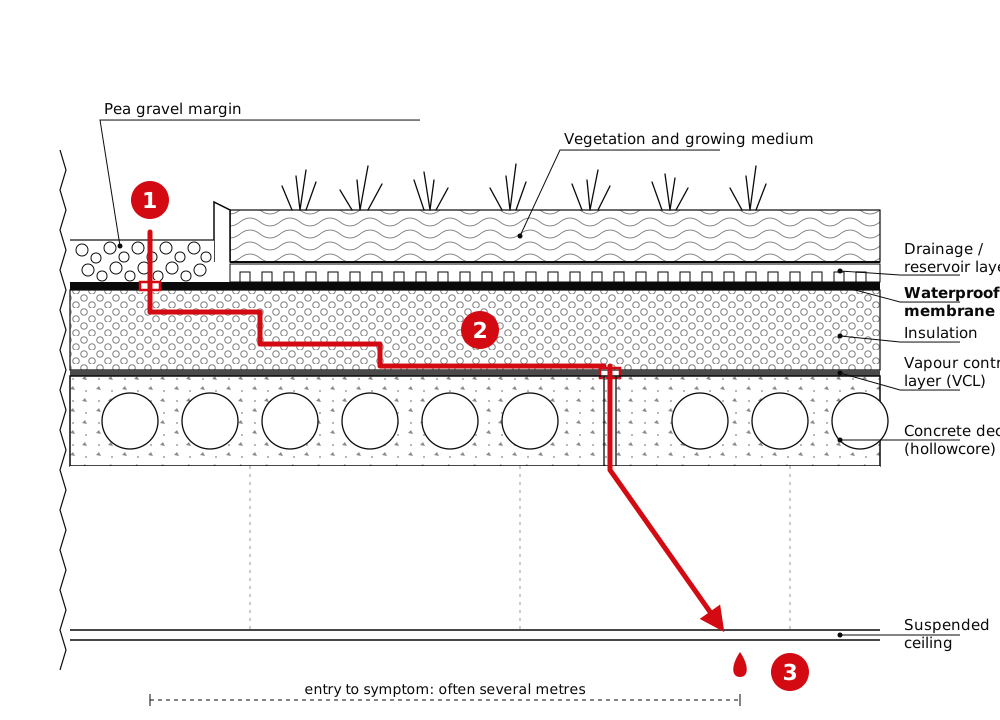
Above the membrane the same thing is happening in the drainage layer, which is designed to move water laterally to the outlets. So water that entered the build-up at one end of the roof can be sitting over a defect at the other.
The practical consequence is blunt. If a contractor lifts the planting above the wet ceiling and finds nothing wrong with the membrane, the membrane there is probably fine. The hole is somewhere else. Repeat that a few times and you have a roof full of patched, disturbed, previously sound waterproofing, a landscape that has been dug up more than once, and the original leak still running. We see roofs that have been “repaired” three and four times this way before anyone locates the defect.
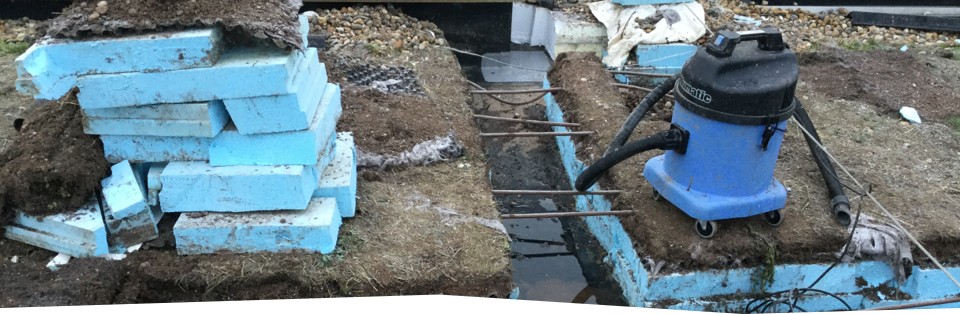
At an occupied extra-care building in Derbyshire, numerous leaks had persisted under the green roofs for years and every conventional attempt to pin them down had come up short, because water was travelling laterally before showing itself below. The full case study is here; the point for now is that they were only found by surveying the membrane through the build-up, not by working back from the ceilings.
Why the usual methods fail on a green roof
Most leak detection assumes you can see or reach the membrane. On a green roof you can do neither, and each of the standard methods fails in a predictable way.
Visual inspection finds nothing, because the membrane is hidden under the planting, substrate and drainage layers.
Dye and flood tests can prove that a roof leaks. But it is very difficult to dam off specific areas down to the waterproofing membrane through a green roof build-up, so they cannot tell you where the leak is.
Thermal imaging only reads the temperature of the surface. On a green roof the surface is vegetation over wet substrate. It is not reading the membrane or the insulation, and the thermal signature of a leaking area is indistinguishable from the rest of the roof.
Conventional electronic leak detection (high-voltage or low-voltage testing) is excellent on an exposed membrane and should form part of the quality assurance process on every buried roof before the overburden goes on. Once the membrane is concealed under substrate, it is very unlikely to be effective.
Moisture mapping is unlikely to be effective through a green roof build-up, and even where it produces a reading it only tells you where water is trapped in the construction, not where it is coming in.
Which leaves the method built for exactly this situation.
Buried leak location: finding the defect through the build-up
Buried Leak Location (BLL) is the survey method built for a membrane you cannot see. A low electrical potential is applied across the roof; the membrane behaves as an insulator, and where water is passing through a breach in it the current follows the same path. The survey reads that from the surface, through the planting and substrate, and plots the readings as a contour map on the roof plan. The breach shows as a clear anomaly at a highly localised position.
Nothing is stripped to do this. The survey team walks the roof; the landscape stays where it is.
What you get from it is not a report saying the roof leaks. You already knew that. You get:
- a contour plot with each breach position marked on the roof plan;
- a recommended opening-up area around each mark, small enough to lift by hand;
- a return visit once the membrane is exposed, to confirm the defect and mark it for repair;
- verification after the repair.
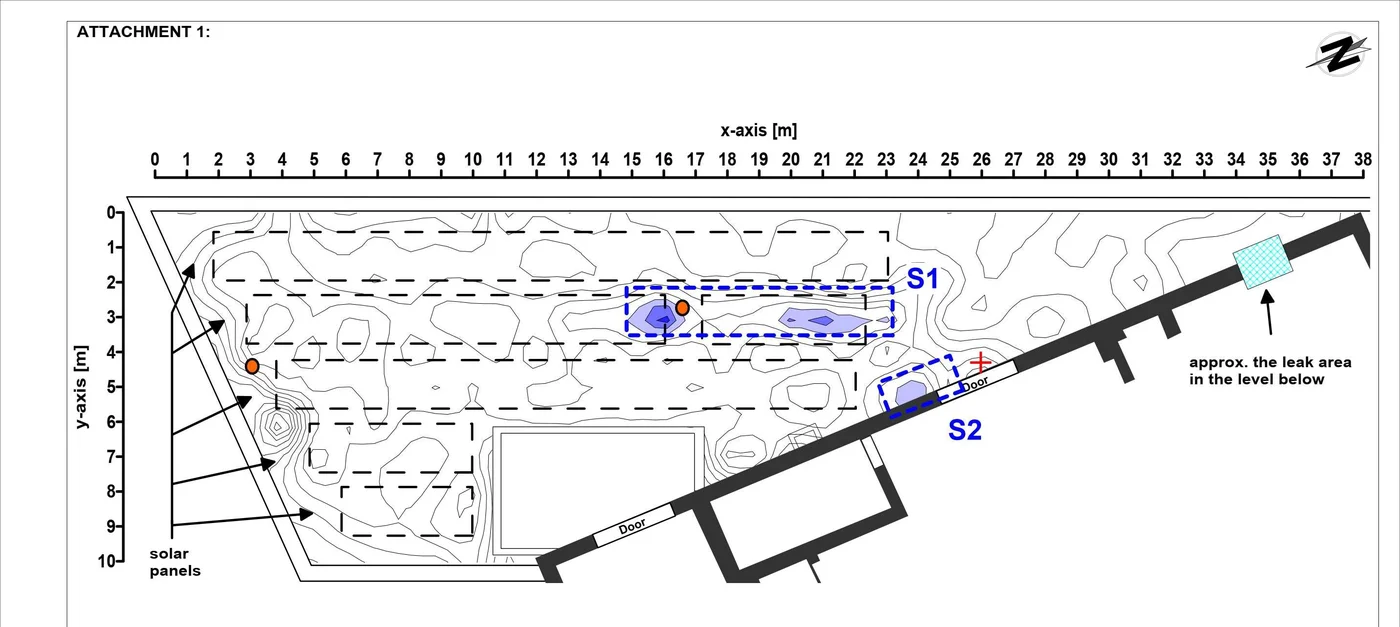
That locate, mark, verify loop is the difference between a survey and a solved roof. The roofing contractor repairs a marked defect, not a search area. At Darley Dale the client’s contract manager described the result as leak locations identified accurately, resolved with precision and minimal disruption, on a building where residents were living under the roofs throughout. Vector is independent of the roofing contractor and the membrane manufacturer, so the finding is the finding.
Two honest limits. BLL works best where there is one waterproofing layer. Multiple waterproofing layers, slip layers and vapour control layers can complicate the readings and make the survey unviable; we establish that from an initial inspection before quoting, not after. And it finds breaches that are currently admitting water, so a defect above the waterline on an upstand that only fails in wind-driven rain from one quarter may need the survey timed accordingly. Neither of those is a reason to start digging.
The service page has the process in detail: Buried Leak Location.
The better answer: a smart leak detection system built into the roof
Everything above is how you find a leak in a green roof that was built without any way of asking it where the water is. There is a better way to build the roof.
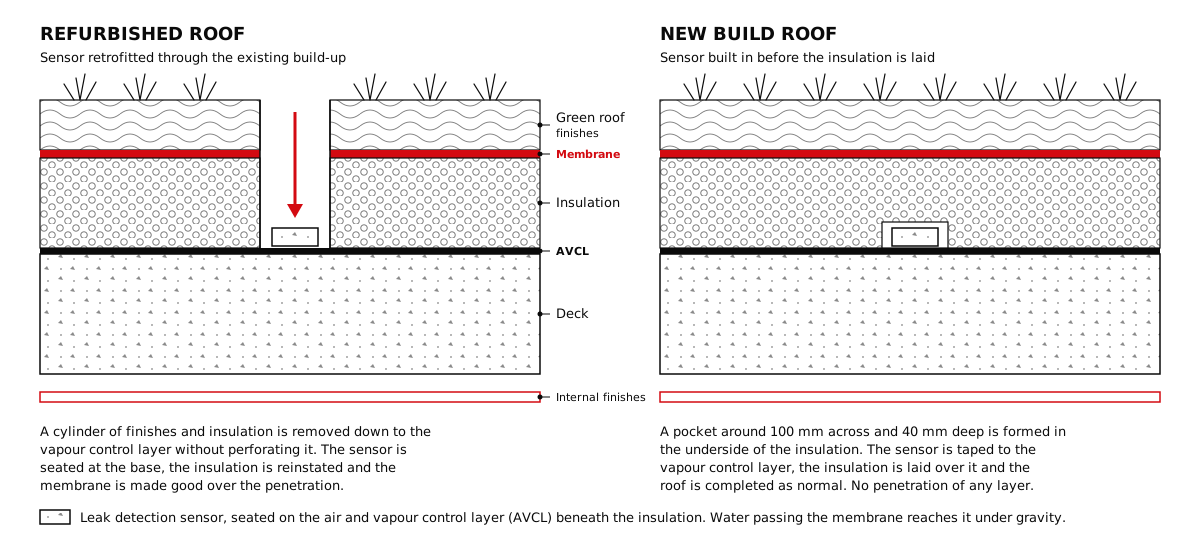
A smart leak detection system (the standards call it permanent leak detection; specifications also say integrated or smart roof monitoring, and they all mean the same thing) puts moisture sensors into the build-up beneath the waterproofing during construction. Water that gets past the membrane travels down through the insulation to the vapour control layer, reaches a sensor, and that sensor’s zone is flagged. The sensors report continuously and nobody has to go onto the roof to read them.
Three things change for a building owner.
You know in minutes, not years. Almost all of the cost of a roof leak accumulates in the gap between the membrane being breached and somebody working out where the problem is and how to fix it. On a green roof that gap is often measured in years, because of the difficulty of identifying the point of ingress and the cost of remediation once it is found. A monitored roof closes it to the time it takes water to reach the deck.
You know when. A monitored roof produces a dated record. When the question later becomes whose defect this is, the contractor’s, the landscaper’s, the PV installer’s, or wear and tear, a timestamp is worth a great deal, and it is the difference between a warranty claim and an argument.
You never open the roof to ask. The alarm tells you which zone has taken water. That narrows the search before anyone lifts a plant, and on a buried roof that is the whole commercial case. If the zone is sized properly, the opening-up to find and repair the defect is affordable; that is the test BS 8102:2022 applies when it accepts permanent leak detection on buried decks, and it is the design decision that matters more than sensor count.
Limitations. A sensor array reports the zone in which water has reached the vapour control layer, not the position of the membrane breach. Final location within the alarmed zone is BLL work, or electronic integrity testing where the membrane is exposed, and it is carried out across one zone rather than the whole roof. Sensors respond to water arriving at the sensing element, so ingress that runs to an outlet or tracks away down a service void without crossing a sensor is not recorded. The baseline governs everything that follows: an array commissioned over a membrane that is already admitting water records the existing defect as the reference condition. The membrane must therefore be integrity tested and any defects repaired before the system is commissioned and before the overburden is placed. BS 6229:2025 requires integrity testing before temporary protection is installed and again after it is removed; the monitoring baseline belongs after the second test.
It can be retrofitted. Sensors are cored through an existing green roof, seated on the vapour control layer and the membrane reinstated over the penetration. That is normally chosen where the roof is buried and investigating it conventionally would cost more than monitoring it, and it is a sensible next step after a BLL survey has found and fixed the current defects. More on the technique in Smart roof monitoring: what it is, how it works, and what it cannot do.
What to do this week if your green roof is leaking
- Map the ingress points and the weather pattern inside the building, on the roof plan.
- Do not lift planting above the wet patch. The defect is very unlikely to be there, and every unnecessary opening-up disturbs sound waterproofing.
- Do not accept a previous repair as evidence that the area is sound until it has been tested.
- Get the membrane surveyed through the build-up by an independent specialist, and insist on marked locations on a plan, not a search area.
- Once it is fixed, ask whether sensors should go in while the roof is open, so this is the last time you go looking.
Related reading
- Buried Leak Location — the service, step by step
- Darley Dale Extra Care: green roof leaks located under an occupied building
- Green roof leak detection: why standard methods fail
- Smart roof monitoring: what it is and what it cannot do
- Roof leak investigation methodology
If your green roof is leaking and you would rather locate the defect than dig for it, talk to Vector.