
For architects
Designing for Sensor-Based Leak Detection
A practical guide to integrating permanent moisture sensors into warm and hybrid roof build-ups — what the standards actually say, where sensors work, and when they're justified.
By Ben Hickman, Technical Director
· 16 June 2026 · Updated 11 September 2026
Contributing author, CIRIA C817 (Blue Roofs) · contributing committee member, BS 8102:2022 revision
The design-stage opportunity
Designing for sensor-based leak detection means deciding where moisture sensors will sit inside the roof build-up while the section is still open — not adding detection to a roof that has already been designed. Two decisions govern everything that follows: the deck type, and whether the sensors need power run through the waterproofing.
Most conversations about leak detection happen after a building leaks. By then the options are forensic, expensive and disruptive.
The architects we work with are increasingly asking a better question: what should we be doing at design stage to make leaks easier to find — or stop them being a problem at all?
This page is written for that conversation. It's not a product pitch. It's an honest look at how sensor-based leak detection works in practice, which roof build-ups suit it, and where the design decisions you make now will determine whether sensors deliver value later.
If you have reached the point of writing it into a specification, see how to specify a smart, integrated leak detection system in a roof build-up. If you want an independent review of a specific design, see our Waterproofing Design Review service — typically free of charge.
The compliance context
The standards have moved — but they have moved by different amounts, and the verbs matter.
BS 8102:2022 — protection of below-ground structures
Section 6.5 Note 2 BS 8102:2022 · Clause 6.5, Note 2 Buried decks below ground level acceptable where permanent leak detection systems are employed such that leak locations can be identified and repairability is achieved
The note applies to warm roof build-ups and loose laid waterproofing systems, and cross-refers to 4.3.2. Read the condition carefully: acceptance is not earned by installing detection, but by installing detection that lets the leak be found and the waterproofing be repaired. A system that raises an alarm without localising the breach does not satisfy it. Note also the scope - clause 6.5 deals with buried decks below ground level, and it opens by distinguishing those from roofs above ground level, pointing to BS 6229 for flat roofs. Extract quoted from BS 8102:2022, © BSI. Summary is Vector’s own wording. Checked against the published standard on 2026-09-11. states that warm roof build-ups and loose laid
waterproofing systems are acceptable on buried decks where permanent leak detection systems are
employed such that leak locations can be identified and repairability is achieved.
Read that condition closely, because it is doing more work than it first appears. Acceptance is not earned by
installing detection. It is earned by installing detection that lets you find the breach and
repair it. A system that raises an alarm without localising the leak does not satisfy the note. The
clause it cross-refers to BS 8102:2022 · Clause 4.3.2 Defects and remedial measures Contingency planning for dealing with any localized defects or system failure that arise should be included
The clause behind 6.5 Note 2, and the reason permanent detection has standing on a buried deck. It accepts that an ideal waterproofing solution would be defect free but that defects might occur - through design, workmanship, materials, or follow-on trades and site operations - and requires the potential for defects to be recognized and catered for in the design, as part of the overall waterproofing design for the structure. It then requires that the issue of repairability is taken into account, and the form and feasibility of remedial measures after completion, with finishes in place, assessed. Extract quoted from BS 8102:2022, © BSI. Summary is Vector’s own wording. Checked against the published standard on 2026-09-11. is where that repairability duty comes from.
Note the scope, too. Clause 6.5 deals with buried decks below ground level, and opens by distinguishing them from roofs above ground level — for which it points to BS 6229.
BS 6229:2025 — flat roofs with continuously supported flexible waterproof coverings
BS 6229:2025 came into effect on 31 December 2025 and supersedes BS 6229:2018, which is withdrawn. It puts
electronic leak integrity testing into the information designers pass to installers BS 6229:2025 · Clause 6.1 s) Exchange of information compliance testing or inspection requirements (e.g. fastener pull-out testing, electronic leak integrity testing)
Item s) of the list of information designers should provide to those installing the roof. It places electronic leak integrity testing in the design-stage information set rather than leaving it to be raised on site once the roof is down. Extract quoted from BS 6229:2025, © BSI. Summary is Vector’s own wording. Checked against the published standard on 2026-09-11. ,
requires the programme to accommodate integrity testing before temporary protection is installed and again
after it is removed BS 6229:2025 · Clause 6.2 g) Project schedule Integrity testing of the roof system that is required before temporary protection is installed, and again after removal.
Item g) of what the roofing programme has to accommodate. Two tests, not one - which matters on any project where a finished membrane is covered to protect it from follow-on trades and later uncovered before handover. The second test is the one that catches damage done while the roof was out of sight. ASTM D8551 4.5 reaches the same conclusion for geomembranes. Extract quoted from BS 6229:2025, © BSI. Summary is Vector’s own wording. Checked against the published standard on 2026-09-11. , and recognises that electronic devices are available to
detect leaks BS 6229:2025 · Clause 8.2, Note 2 Inspections - electronic devices Electronic devices are available to detect leaks and heat loss.
A note attached to the inspection list. It is the British Standard acknowledging electronic detection as part of the flat roof inspection toolkit - recognition, not a requirement that every roof be electronically tested or permanently monitored. Cite it as exactly that. Extract quoted from BS 6229:2025, © BSI. Summary is Vector’s own wording. Checked against the published standard on 2026-09-11. .
That last one is recognition, not a mandate. Anyone citing BS 6229 as though it requires permanent monitoring is overstating it. See our clause-by-clause guide to BS 6229:2025.
CLT and mass timber
BS 6229:2025 takes a markedly cautious position on timber roof decks BS 6229:2025 · Clause 5.2 Roof slab/deck materials The use of cross-laminated timber (CLT) decks in flat roofs should be designed out wherever possible.
Where CLT is used, the clause calls for a finished fall of not less than 1:40, measures to protect the structure from moisture during construction, and roof finishes withheld until the timber is at a moisture content, through its full thickness, at which fungal decay does not occur - 20% is given as the recommended target. It closes by calling for inspection and testing regimes to be scheduled both during construction and throughout the service life of the building, so that decay can be caught early. Extract quoted from BS 6229:2025, © BSI. Summary is Vector’s own wording. Checked against the published standard on 2026-09-11. : CLT decks
in flat roofs should be designed out wherever possible, and where CLT is used, inspection and testing regimes
should be scheduled both during construction and throughout the service life of the building. The 2024 Joint
Code of Practice identifies moisture content as the key factor for mass engineered timber.
CIRIA C817 — blue roofs
CIRIA C817 is the definitive UK guidance on blue roof design, implementation and monitoring, and Vector's
Ben Hickman is a named author of it. Section 3.2.3 CIRIA C817 (2024) · Clause 3.2.3 Warm blue roof consideration should be given to the installation of a permanent leak detection system
The reasoning is repairability. The clause opens by observing that warm blue roofs are difficult to repair because locating a leak in the waterproofing is very difficult, which can mean extensive removal of overburden or even complete replacement of the waterproofing system. It then distinguishes system capabilities: passive systems needing manual analysis, automatic systems that analyse data, telemetry alerts to a building management company, defect location grids that narrow a defect to a specific area, and capture of physical dimensions such as hygrothermal data. The accompanying pros-and-cons table lists the absence of permanent leak detection as a drawback of the warm build-up, because it makes identifying defect locations extremely difficult. Extract quoted from CIRIA C817 (2024), © CIRIA. Summary is Vector’s own wording. Checked against the published standard on 2026-09-11. recommends that
consideration be given to installing a permanent leak detection system on a warm blue roof. It does
not require one, and we will not tell you it does.
The reasoning is what makes it persuasive rather than the verb. Warm blue roofs are very difficult to repair,
because locating a leak in the waterproofing is very difficult — which can mean extensive removal of
overburden or complete replacement of the waterproofing system. The same logic appears again in the
waterproofing section CIRIA C817 (2024) · Clause 3.26, “Repairability” Waterproofing - Repairability Where alternative waterproofing systems or build-ups are used, consideration should be given to the use of permanent leak detection systems.
The passage begins from the practical point that repairing a defect in a blue roof requires locating it first, and that the waterproofing design should give this due consideration to ensure repairability - citing BS 8102:2022 directly. It notes that locating defects is easier where monolithic structural substrates and fully bonded waterproofing are used; the quoted recommendation is what follows for everything else. Printed page 60. Extract quoted from CIRIA C817 (2024), © CIRIA. Summary is Vector’s own wording. Checked against the published standard on 2026-09-11. , which ties it directly back to BS 8102:2022.
C817 is firmer on who should do the checking: quality assurance should be provided by a suitably trained,
competent and independent third party CIRIA C817 (2024) · Clause 3.26.6 Robust waterproofing - Quality assurance A suitably trained, competent and independent third party should provide quality assurance.
It adds that membership of the Roof and Waterproofing Test Association (RAWTA) may show such competence, and that the waterproofing designer should include a statement on the recommended quality assurance test procedure - giving electronic integrity testing (only to be used with conductive substrates), flood testing and adhesion testing as examples. Quality assurance should include visual inspection at every stage of the waterproofing application, before cover-up of the waterproofing layer, with any identified defects repaired by the waterproofing contractor and re-tested. Extract quoted from CIRIA C817 (2024), © CIRIA. Summary is Vector’s own wording. Checked against the published standard on 2026-09-11. , and the
waterproofing system should be tested by an independent third party to confirm integrity before
handover CIRIA C817 (2024) · Clause 4.5 Testing and inspection it should be tested by an independent third party to confirm integrity, such as RAWTA or accepted equivalent
This applies before handing over the waterproofing system. The clause also recommends a level survey of the roof support structure to confirm there are no backfalls, with remedial action before the waterproofing is installed. Its quality assurance list runs: visual inspections, electronic leak detection (for conductive materials), vacuum testing, hydraulic tests, adhesion tests, potential load testing, and flood testing where possible. Extract quoted from CIRIA C817 (2024), © CIRIA. Summary is Vector’s own wording. Checked against the published standard on 2026-09-11. .
The build-ups that work for sensors
Warm deck — best fit
A continuous platform beneath the waterproofing. Moisture spreads predictably and sensors pick it up wherever it arrives. NHBC has effectively walked away from cold decks — the industry is moving here anyway.
Hybrid deck — workable
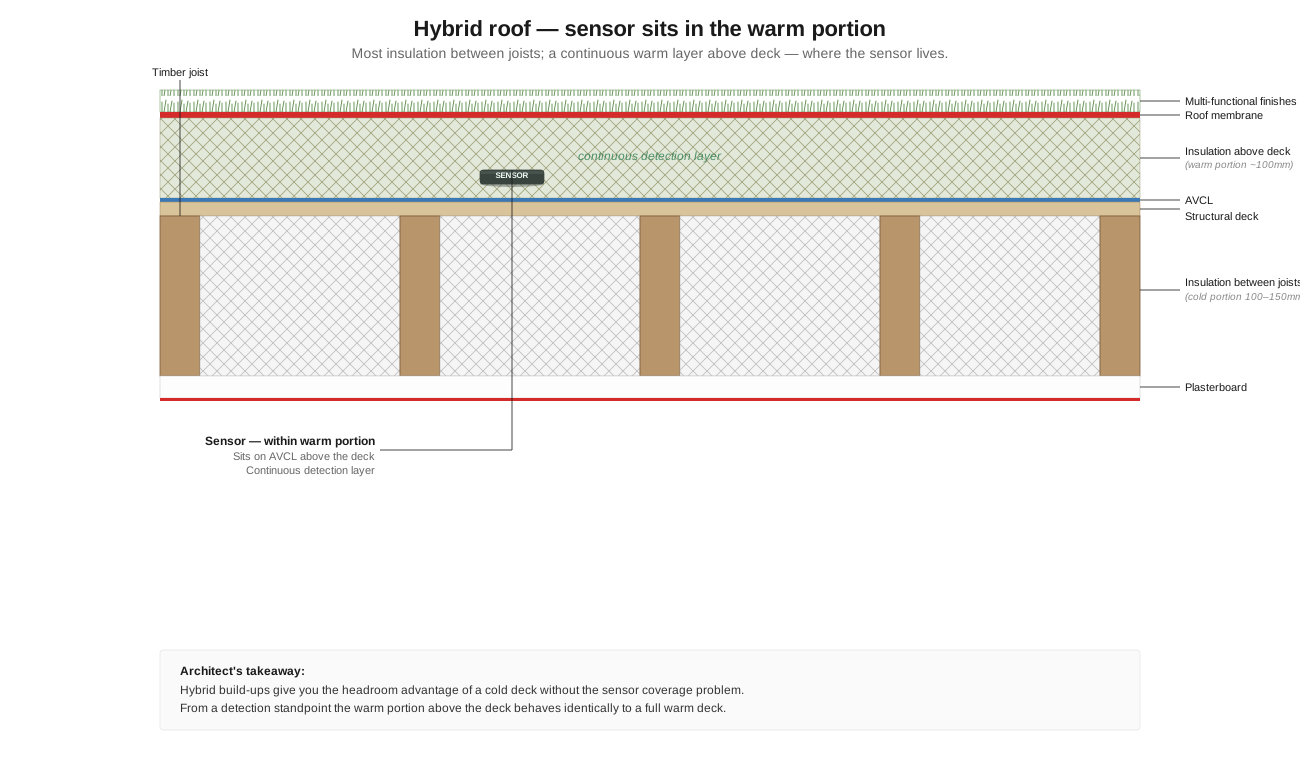
Some insulation between joists, some above. Behaves enough like a warm deck for sensors to perform properly. Often the right answer when headroom is tight.
A note on cold decks. Cold deck construction adds complications that fall outside the scope of this page. If you're working on a cold deck project where sensor monitoring matters, get in touch.
Section diagrams
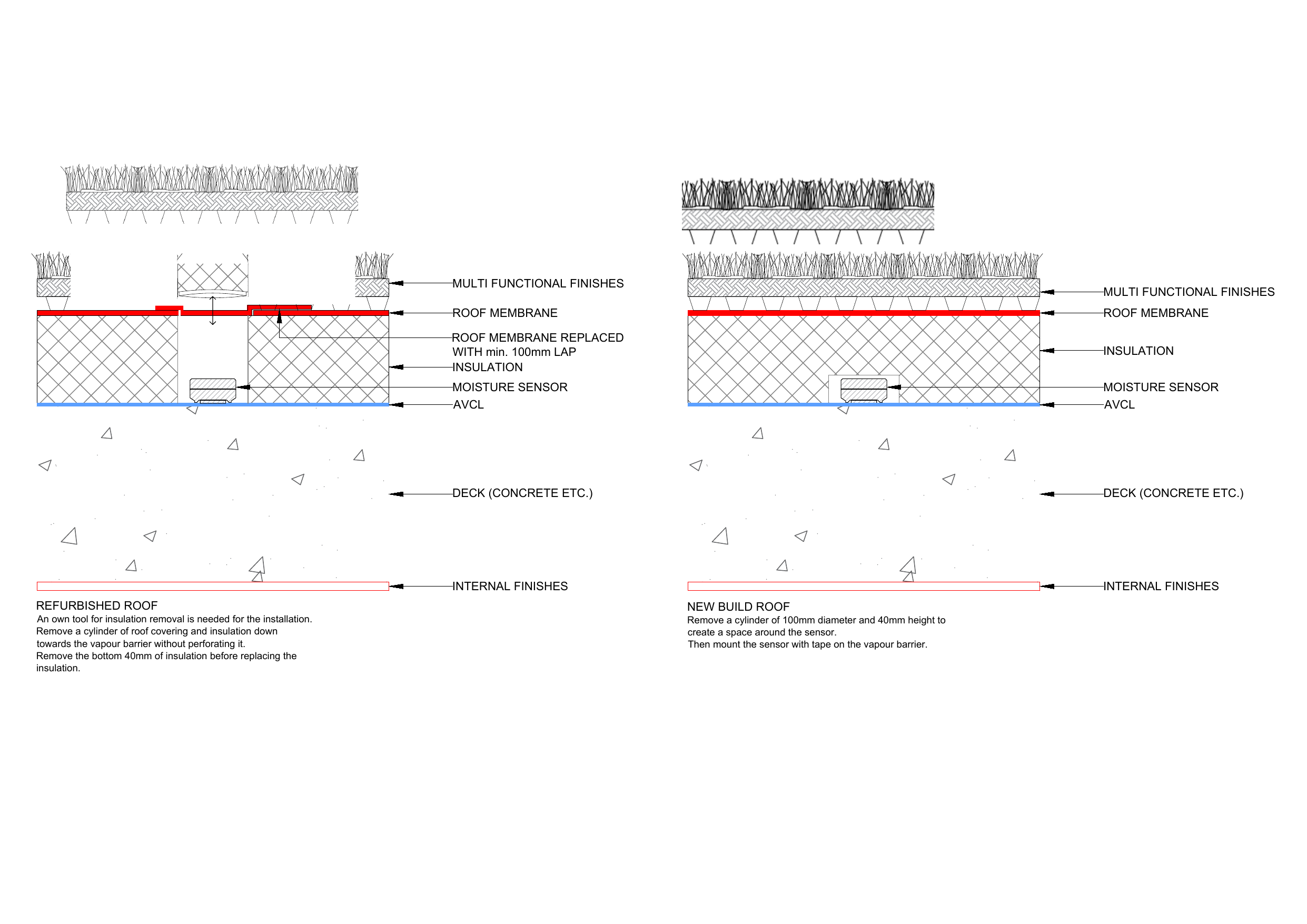
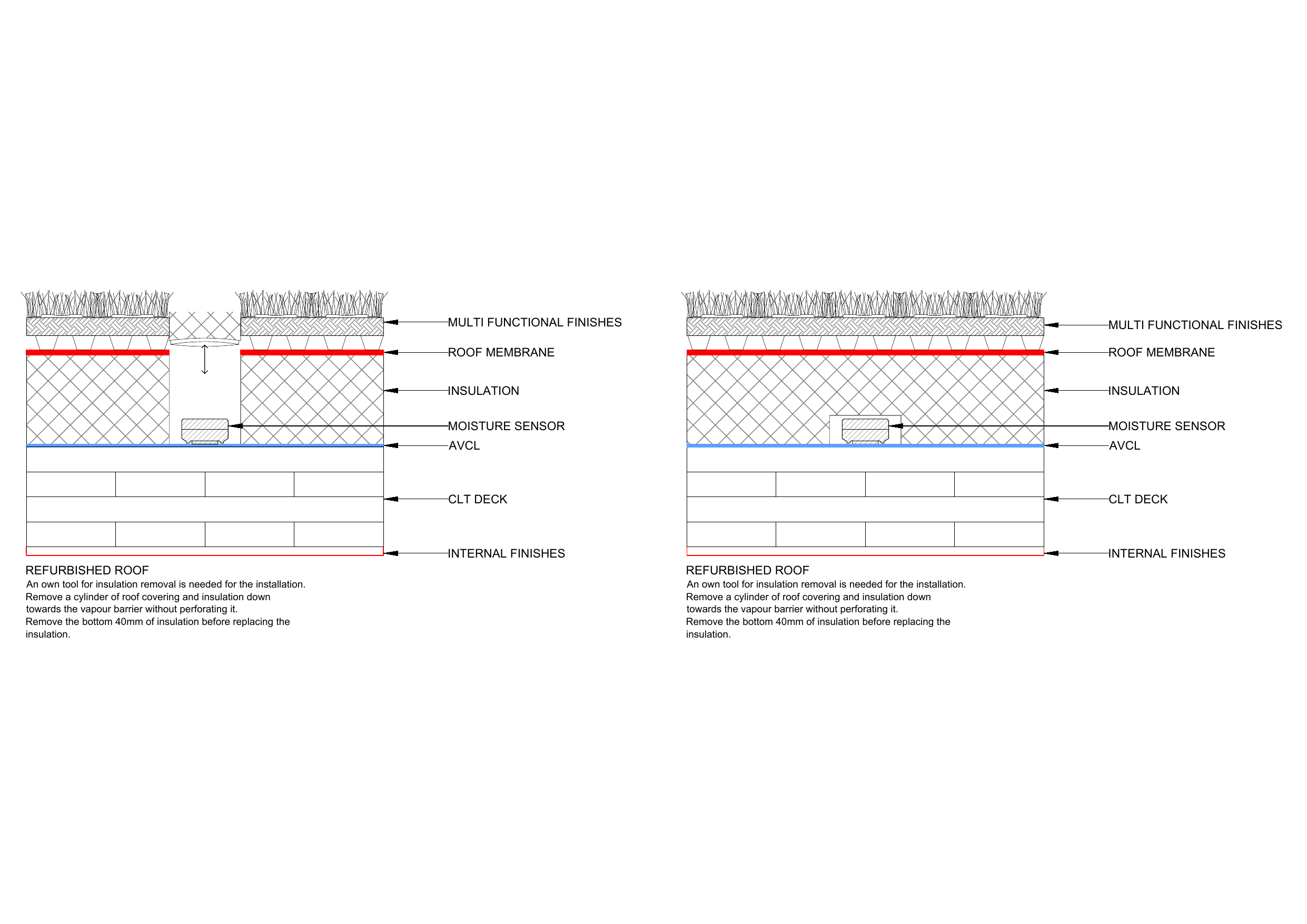
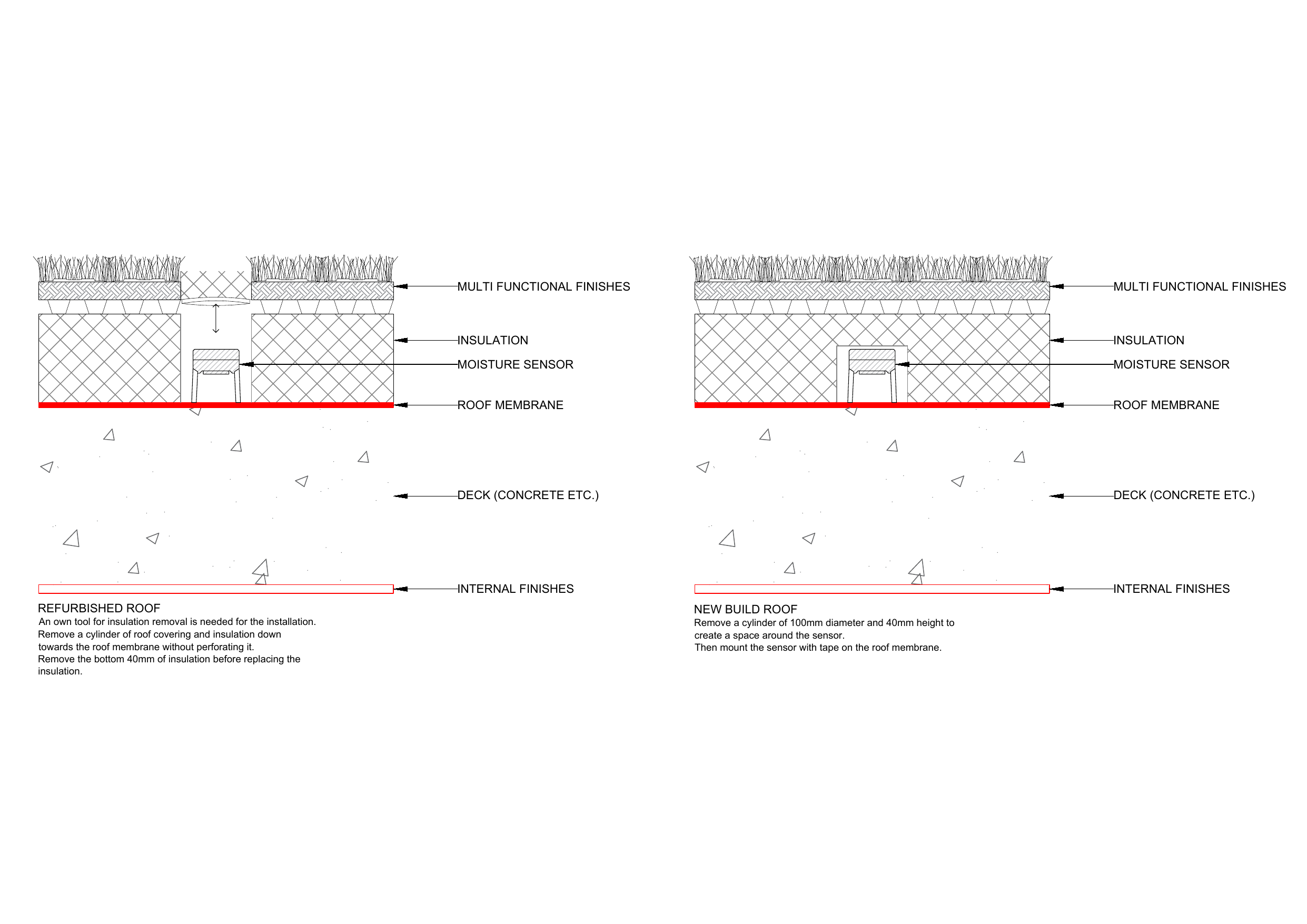
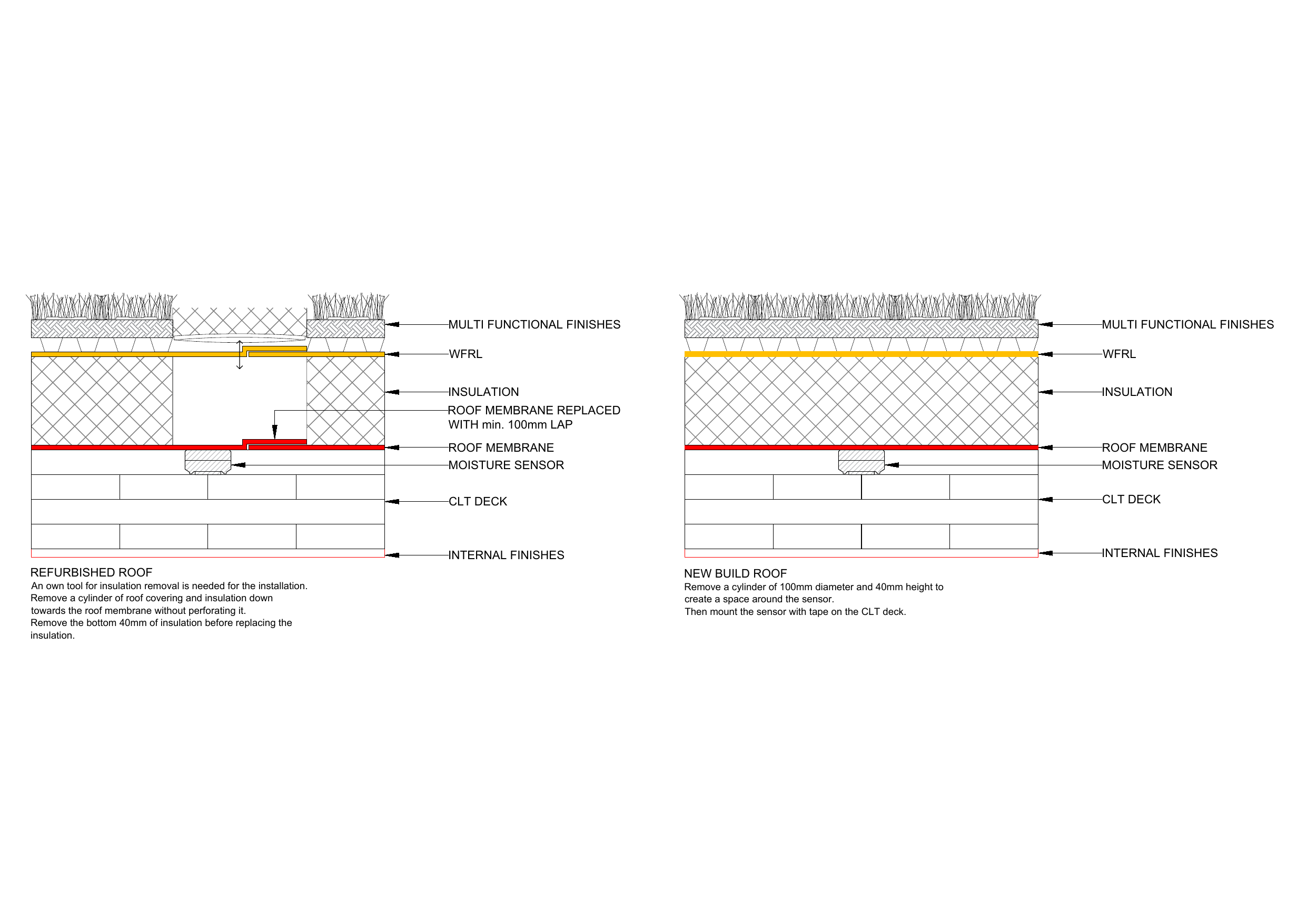
Where the sensors sit in the build-up. Click any image to view full size.
What the sensors actually look like
Size
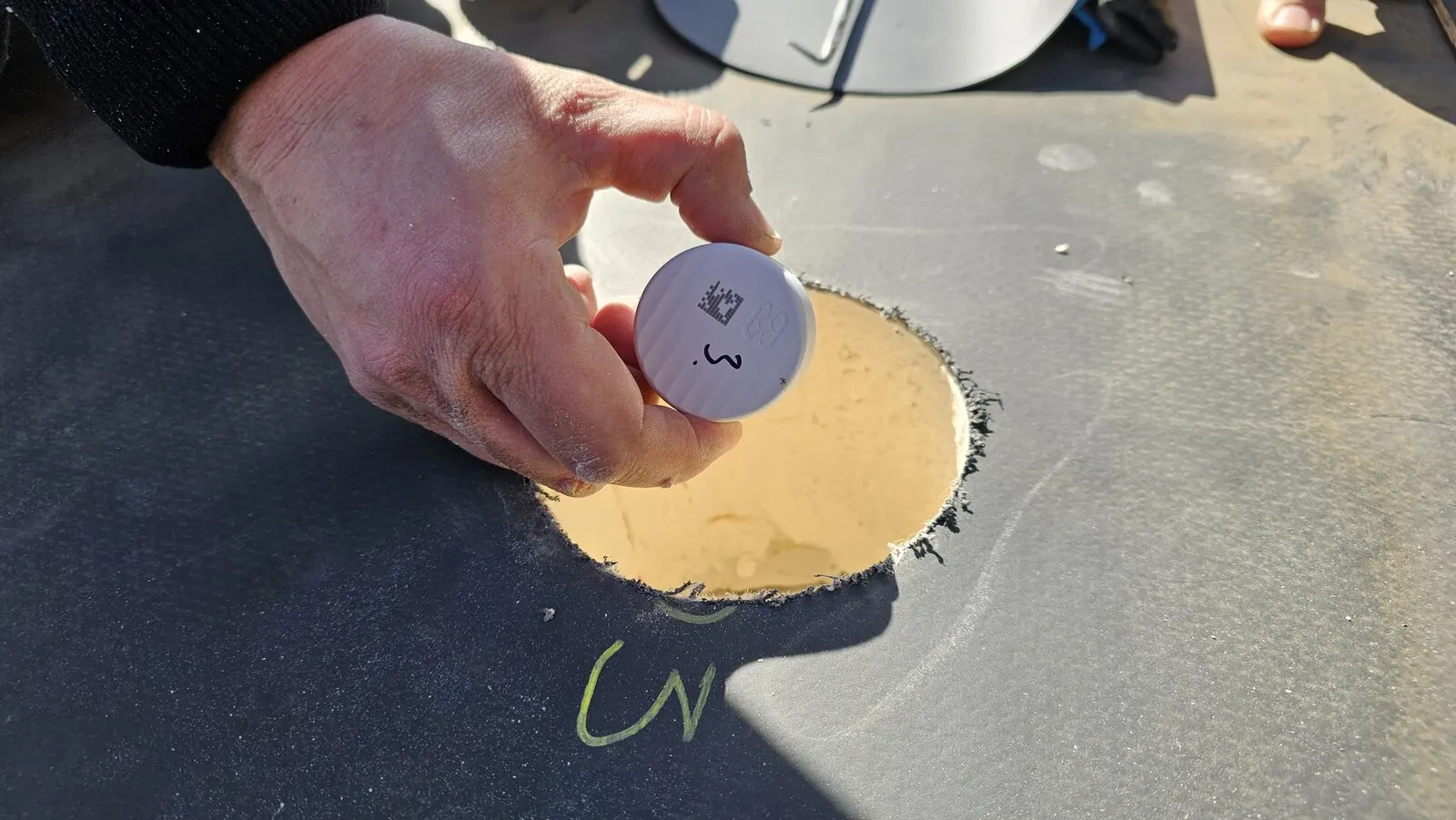
Approximately the dimensions of an ice hockey puck.
Depth
~40 mm — fits within most insulation gaps.
Weight
Very light, easily handled in one hand.
Power
Battery powered — crucially not mains.
Why battery matters: a mains-powered sensor needs a cable run, and a cable run almost always means a penetration through the waterproofing. Battery life is measured in decades.
Where to place them
In a warm deck
Directly on the deck, beneath the waterproofing.
In a hybrid
On the deck within the warm portion of the build-up.
On a refurbishment
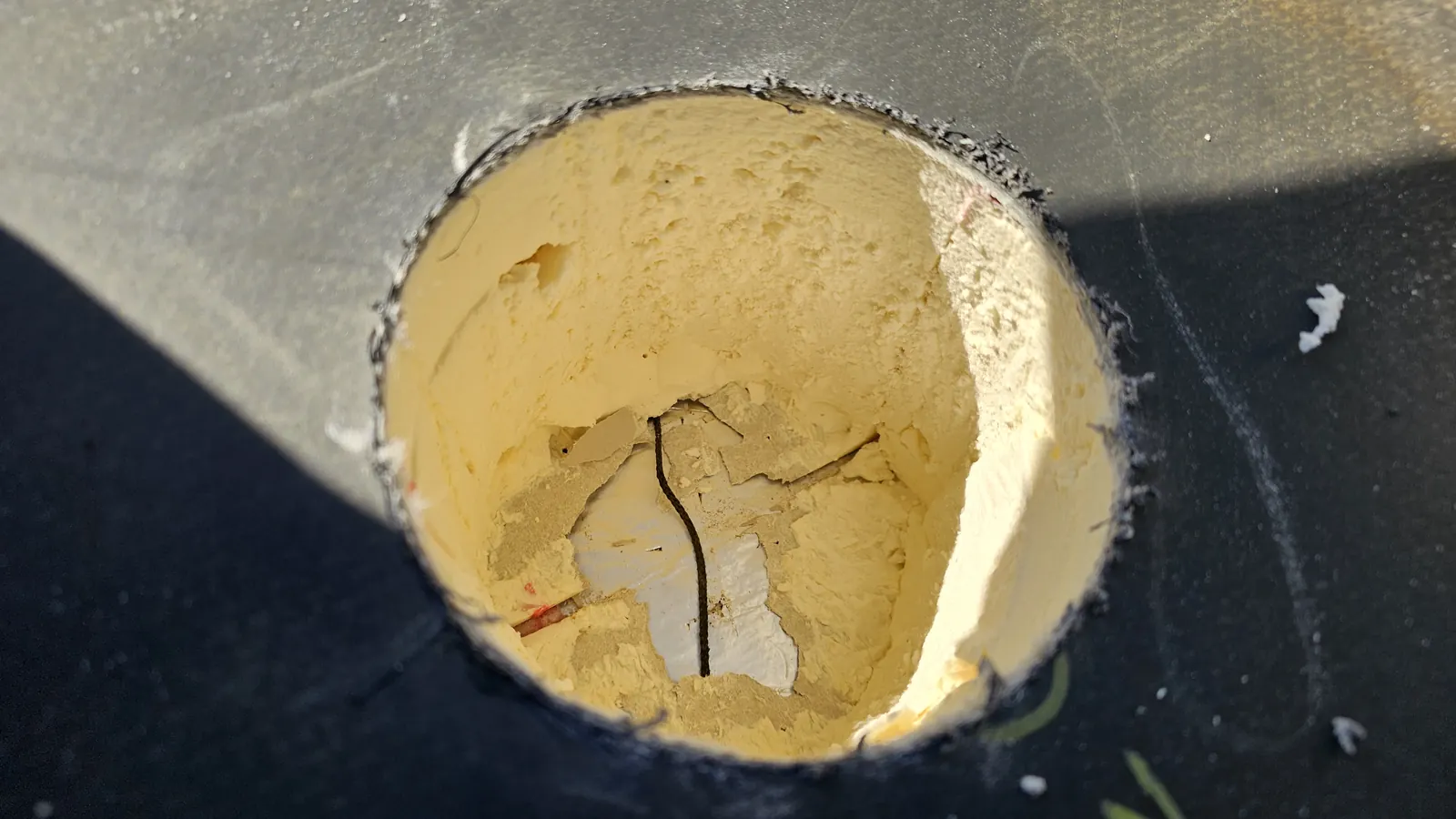
A 100 mm cylinder of insulation is removed and replaced around the sensor, with a 100 mm membrane lap restoring the waterproofing above.
When is a sensor system justified?
Sensors make most sense where:
- The asset has high value and a leak would cost significantly more than the system to install
- The roof carries finishes that make leak location difficult — green roofs, paved terraces, running tracks, mature planting
- The roof sits above sensitive use — data centres, archives, premium residential, server rooms, art storage
- The client wants the certainty that comes with knowing about a leak in hours rather than months
If the building is a low-rise warehouse with a bare membrane and easy access, sensors are probably not the right spend.
Think of sensors the way you'd think of tyre pressure sensors on a car. On the right asset, that's a transformative capability. On the wrong asset, it's an unnecessary feature.
How Vector fits in
Three services cover the full sensor lifecycle. They can be taken individually or as a single appointment under our Complete Roof Assurance offer.
At design stage
Waterproofing Design Review. Independent check on your section, sensor layout opinion, performance-spec language contractors can price. Typically free of charge.
During construction
Quality assurance inspections, sensor commissioning, integrity testing of the membrane before it's concealed.
Post-completion
Permanent Leak Detection & Sensor Monitoring. Continuous monitoring, real-time alerts, biannual roof inspections to BS 6229 Clause 8.2, planned preventative maintenance.
Who this suits
- High-value commercial — data centres, headquarters, mixed-use
- Premium residential — particularly schemes with hidden roof finishes
- Cultural and institutional buildings
- Any roof where access for leak investigation will be difficult after handover
Submit your design for review
Send us your section. We'll come back with a sensor-layout opinion, a coverage assessment, and an honest view on whether this is the right system for your project.
Frequently asked questions
What does designing for sensor-based leak detection mean?
It means deciding, at design stage, where moisture sensors will sit inside the roof build-up and choosing a build-up that suits them — rather than adding detection to a roof whose section has already been frozen. The two decisions that have to be made early are the deck type (warm, hybrid or inverted) and whether the sensors will be battery powered or need a cable run through the waterproofing.
Which roof build-ups suit sensor-based leak detection?
Warm decks are the best fit — a continuous platform beneath the waterproofing where moisture spreads predictably. Hybrid decks also work well. Cold decks add complications and need a project-specific conversation.
Where exactly do the sensors sit in the build-up?
In a warm deck, directly on the deck beneath the waterproofing. In a hybrid, on the deck within the warm portion of the build-up. On a refurbishment, a 100 mm cylinder of insulation is cored out and replaced around the sensor, with a 100 mm membrane lap restoring the waterproofing above.
How big are the sensors and do they need power cables?
Each sensor is about the size of an ice hockey puck, around 40 mm deep, and battery powered — crucially not mains, so there is no cable run and no penetration through the waterproofing. Battery life is measured in decades, not years.
At what RIBA stage should this be decided?
Stage 3. That is when the thermal envelope strategy is settled and warm-versus-inverted is genuinely still open. Once the roof section is frozen, an integrated detection layer stops being a design decision and becomes a negotiation — usually with the membrane supplier, over penetrations.
When is a sensor system actually justified?
Where the asset value is high, the roof finishes make leak location difficult (green roofs, terraces, mature planting), the space below is sensitive (data centres, archives, premium residential), or the client wants to know about a leak in hours rather than months. On a low-rise warehouse with a bare membrane and easy access, it is not the right spend.
What do the standards actually say about designing for sensors?
Be precise about the verbs, because they differ. BS 8102:2022 Section 6.5 Note 2 accepts warm roof build-ups and loose laid waterproofing on buried decks below ground level where permanent leak detection systems are employed such that leak locations can be identified and repairability is achieved. CIRIA C817 Section 3.2.3 recommends that consideration be given to installing a permanent leak detection system on a warm blue roof — it does not require one. BS 6229:2025 names electronic leak integrity testing in the information designers pass to installers at 6.1 s), and recognises electronic detection devices in Note 2 to Clause 8.2. Only BS EN 16893:2018, for heritage collections, uses shall.
How does this relate to electronic leak detection testing?
Sensors monitor; electronic integrity testing proves the membrane was sound at a moment in time. A well-specified roof does both — test before the membrane is concealed, then monitor for the rest of its life. See permanent monitoring vs electronic integrity testing.
Related technical resources
How to specify an integrated system · BS 6229:2025 · BS 8102:2022 · CLT moisture thresholds · Monitoring methods compared